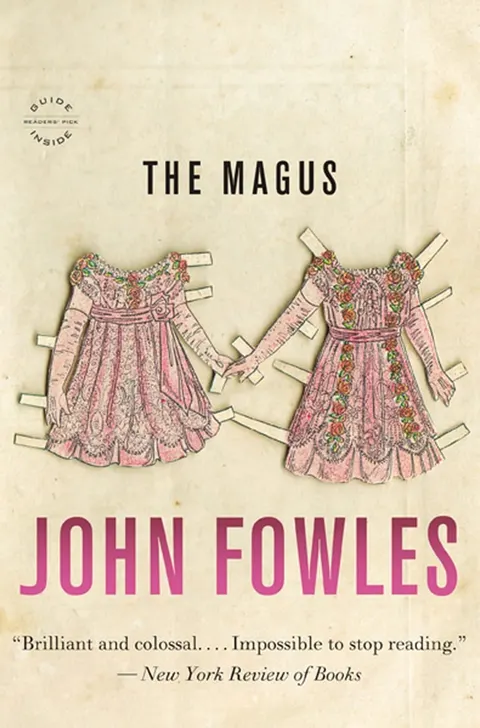
The Magus
John Fowles
Bored with life in London, a young English teacher meets a rich, enigmatic man on a Greek island, and the line between reality and theatre begins to vanish.
The Magus is John Fowles's novel, published in 1965 and revised in 1977. Nicholas Urfe, a young Oxford graduate, leaves his girlfriend Alison in London to teach English on Phraxos, a Greek island. There he meets the wealthy, mysterious Maurice Conchis and is drawn into an elaborate psychological game in which reality and performance blur. It is as much a coming-of-age story as a mystery, built around deception, freedom and self-knowledge.
Nicholas Urfe has studied at Oxford and wants to be a poet, but he sees himself as above ordinary life. When his relationship with Alison Kelly, a young Australian woman he met at a party in London, starts to feel like a commitment, he all but flees to Greece to teach English at the Lord Byron School on the fictional island of Phraxos. Before long he is bored, lonely and depressed.
On one of his walks he stumbles on an estate and meets its owner, Maurice Conchis, a wealthy recluse. Conchis is cultured, courteous and mysterious, and he slowly reveals that he may have collaborated with the Nazis during the Second World War. Nicholas is invited back to the villa again and again. There past and present blur, Conchis seems to live inside the stories he tells, and Nicholas no longer knows what to believe.
Conchis draws Nicholas into increasingly elaborate psychological games and masques, which the novel calls the godgame. They include re-enactments of the Nazi occupation, absurd playlets after Sade and obscene parodies of Greek myths. Nicholas falls in love with a young woman who plays Lily, Conchis's former love, in the masques; as her names and roles keep changing, who she really is grows ever harder to tell.
At first Nicholas treats the games as a joke and assumes they are about Conchis's own life. Gradually he loses the ability to tell what is real and what is artifice, and against his will he becomes a performer in the godgame. Eventually he realises that the scenes are not about Conchis at all, but about him. His pride is wounded and he is furious, yet he cannot walk away, because the game both enchants and humiliates him.
As the story goes on, the game reaches into the life Nicholas left behind in London. He meets Alison again in Athens and tells her about the other woman; afterwards it appears that Alison has taken her own life. Even so, Nicholas keeps chasing the woman from the masques. This is the novel's harshest moral test: the real subject of the game is how Nicholas treats other people.
Nicholas narrates the story and at first seems a reliable guide. But as the pages turn, the way he justifies himself, the way he sees women and his belief in his own importance begin to unsettle the reader. Fowles deliberately makes his narrator flawed; the test is not only about the outside world but about Nicholas's own self. Fowles based the island partly on his own experience on Spetses, where he taught English for two years at the Anargyrios School.
At times Conchis's game looks like a psychological experiment, with Nicholas's reactions being observed and his limits tested. At other times it looks like a kind of philosophical education, as if Conchis wants to teach him to see his life and choices differently. The book moves between the two possibilities and never fully confirms either.
One day Nicholas is drugged and taken to an underground space, where he is made to sit in judgement on the people he knew from the game. He refuses to punish the woman he loves. When he is released he learns he has been dismissed from his job and returns to Athens, where he discovers that Alison's suicide was not real. In England he meets Lily de Seitas, who tells him that everything was done for his own good, to make him a better person, and advises him to wait for Alison.
Meanwhile Nicholas begins a relationship with a woman called Jojo, but cannot help hurting her. At last he meets Alison in a park, and the novel closes while the two are still negotiating whether to rebuild their relationship. The ending is left open; Fowles always declined to say which way it goes.
The Magus reads like a thriller but is more than one. Fowles wants the reader, like Nicholas, to be unsure what to believe, and he pulls it off with great skill. His refusal to explain the ending leaves the verdict to the reader.
It is one of the more debated classics of twentieth-century British fiction. Fowles began it in the 1950s under the title The Godgame; it was the first novel he wrote but his third book to be published, after The Collector (1963) and The Aristos (1964). He kept reworking it and published a revised version in 1977. It was filmed in 1968, directed by Guy Green from Fowles's own screenplay, with Michael Caine and Anthony Quinn, but the film is generally considered a failure.
Another pleasure of the novel is that it misleads the reader along with Nicholas. Everyone senses at some point that someone is pulling the strings, but not who or why. What remains in the end is less a solved puzzle than a question that lingers: which of the scenes staged around us do we take to be real?
For: Readers who enjoy intricate plots and psychological games, and those who have read other Fowles novels such as The French Lieutenant's Woman.
John Fowles
Updated: 10 November 2026