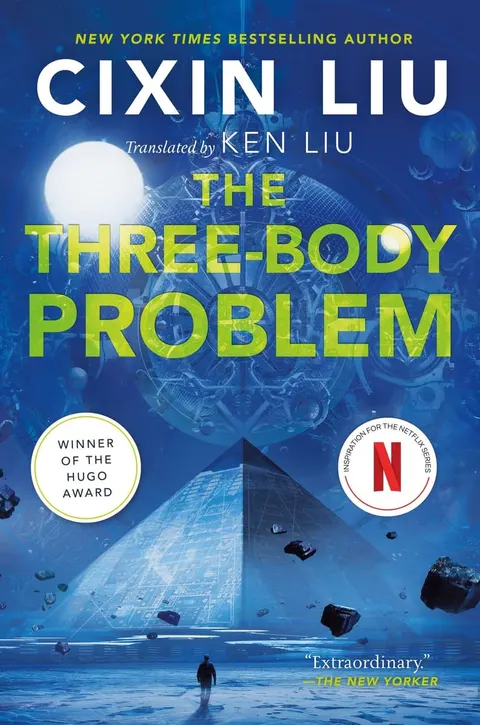
The Three-Body Problem
Cixin Liu
A single step taken in a brutal scene of the Cultural Revolution opens the door, decades later, to a secret that drives the world's best scientists to take their own lives one by one.
The Three-Body Problem is Chinese writer Liu Cixin's science fiction novel, serialized in 2006 and published as a book in 2008. Ken Liu's English translation, published in 2014, brought it worldwide fame and won the Hugo Award for Best Novel. The book moves between two times: an astrophysicist's trauma during the Cultural Revolution of the 1960s, and a present-day nanomaterials researcher investigating the mysterious deaths of scientists. The two threads meet in an unexpected truth about humanity's first contact with the universe. It blends hard science fiction with Chinese history and philosophy.
The Cultural Revolution is raging. Astrophysicist Ye Wenjie watches her father, the physicist Ye Zhetai, beaten to death by Red Guards at a struggle session; her mother, Shao Lin, is among those who denounce him. The event shakes her faith in humanity to the core. She is sentenced to a labor camp and then recruited to Red Coast, a secret military project trying to contact extraterrestrial intelligence.
There Ye Wenjie discovers she can use the Sun as an amplifier to send radio signals across vast distances, and she secretly broadcasts a message. Eight years later a reply arrives from Trisolaris, a planet in the Alpha Centauri system, warning her not to communicate again or Earth's location will be revealed. But Ye Wenjie has given up on humanity, and she decides to answer.
In the present, nanomaterials researcher Wang Miao learns that respected scientists are taking their own lives one after another. As he investigates with Shi Qiang, known as Da Shi, a coarse-looking but razor-sharp police officer, a countdown begins appearing before his eyes, even showing up in the photos he takes. It stops only when he pauses his research.
Wang Miao enters an online virtual reality game called Three Body. It depicts civilizations rising and falling on a chaotic planet under the pull of three suns. The more he plays, the more he understands that it is not just a game but the true story of another world.
A book Ye Wenjie read during her years at Red Coast also shapes her decision: Rachel Carson's Silent Spring, lent to her in 1969 by the journalist Bai Mulin. Its account of the damage humans do to nature reinforces her belief that humanity cannot correct itself. Combined with the violence of her youth and her fear of ecological disaster, it leads her to see outside intervention as hope.
The Three Body game is one of the book's most inventive parts. In it Wang Miao enters the eras of historical figures such as King Wen of Zhou, the philosopher Mozi, Copernicus, Newton and Qin Shi Huang, China's first emperor. Civilizations are built and destroyed between the planet's chaotic and stable eras. These scenes convey how perilous life on Trisolaris is and weave pieces of the history of science into the story in surprising ways.
As Wang Miao and Da Shi's investigation proceeds, the structure of the Earth-Trisolaris Organization comes to light. It was founded and financed by Mike Evans, heir to the world's largest oil company and a radical environmentalist, with Ye Wenjie as its leader. Its members split into factions: some want humanity destroyed, others want to help solve Trisolaris's problem. In a raid on the organization's meeting, Ye Wenjie is captured.
As the Trisolaran fleet sets course for Earth, due to arrive in about four hundred and fifty years, sophons, tiny supercomputers embedded in single protons, sabotage particle accelerator experiments on Earth; the scientists' suicides are tied to this collapse. When a Trisolaran message arrives calling humans bugs, Shi Qiang takes Wang Miao to a small town overrun by locusts: humans have far surpassed insects in technology, yet insects have never been wiped out. Wang Miao decides to return to work. Ye Wenjie, now old and ill, climbs to the ruins of Red Coast, watches the sunset and reflects that it is her own sunset, and humanity's too.
The Three-Body Problem is gripping even for people who have not read science fiction in a long time. Its ideas are huge and its storytelling fluid. Liu Cixin works physics problems into the plot, informing and astonishing the reader at once.
It is the first book of the Remembrance of Earth's Past trilogy, and the series was adapted by Netflix as 3 Body Problem in 2024. It marked a turning point in bringing Chinese science fiction to the world stage.
Another appeal is how a scientific problem becomes a human story. An abstract physics question like the three-body problem becomes a metaphor for real fate. Liu's universe is dark and silent, but the gaze that describes it is passionate.
The first hundred pages can move slowly, but once the Cultural Revolution scenes and the present-day investigation intersect, the pace picks up. Getting used to the Chinese names may take a little time; keeping the main characters in mind is enough. Read patiently, the final chapters deliver one of science fiction's most powerful ideas.
For: Lovers of hard science fiction and big ideas, and readers interested in Chinese history and science.
Cixin Liu
Updated: 10 November 2026