History books worth reading: 15 from Byzantium to Sapiens
Fifteen history books worth reading, from Sapiens and Guns, Germs, and Steel to The Guns of August, Atatürk and Byzantium, plus a reading order.
0/15 books read0%
History books come in two kinds that are easy to confuse. Some tell you what happened: a war, a reign, a voyage, told closely enough that you feel you were there. Others try to tell you why things happen at all: why some societies conquered others, why disease has mattered more than generals, why violence has risen or fallen. The best reading list mixes both, because the big theories only make sense with real stories in your head, and the stories gain depth when you know the forces behind them.
Read more
The fifteen books below are arranged with that in mind. The first group covers a part of the world that general lists often skip: the eastern Roman Empire, the last years of the Ottoman Empire, and the life of Mustafa Kemal Atatürk, who built a republic from what remained. The second group is the grand view, with five books that each try to explain the whole of human history through a single lens: cognition, geography, disease, long experience, or the decline of violence.
The third group looks at modern history from three angles: from below, through the eyes of ordinary people; from the top, through the decisions that started the First World War; and across a whole continent after 1945. The last group is history as narrative, including two novels and two true adventure stories. They are the most enjoyable books on the list and a good way to persuade a friend that history is not a dry subject.
Several of these books are debated, and that is part of their value. Guns, Germs, and Steel has been criticised by specialists; A People's History of the United States has fierce critics and fierce defenders. Reading a contested book alongside a more conventional one is one of the best ways to learn how history is actually written: as an argument about evidence, not a list of dates.
Who it is for: Readers who enjoy history but do not know where to go next, and newcomers who want readable books that explain how the world came to be the way it is.
Group 1: Byzantium, the Ottomans and modern Turkey
Three books that follow one region across more than fifteen centuries, from Constantine's eastern Roman Empire to the founding of the Turkish Republic. Read in order, they make a single long story about empires, their endings and what came after.
Anthony Kaldellis, a historian and Byzantinist at the University of Chicago, tells the history of the eastern Roman Empire, usually called Byzantium, from Constantine to 1453. Its title signals how he wants you to see Byzantium: as Roman.
Read more
It is a major, full-length history, and it gives the background that later Ottoman and Turkish history rests on.
For: Readers who know Rome and want to understand what happened in the east after it.
While reading: It is a long book. Treat it as a series of reigns and take breaks between centuries.
Next: Jump forward to The Fall of the Ottomans to see the empire that replaced Byzantium in its last years.
Eugene Rogan, a professor of modern Middle Eastern history at Oxford, writes about the Ottoman Empire's last years and the First World War in the Middle East. That war is usually told from the Western Front; Rogan's subject is the Middle East, a part of the conflict many readers know only in fragments, and the end of an empire that had lasted for centuries.
Read more
For: Readers who want to understand the origins of the modern Middle East and Turkey.
While reading: Keep a map of the region nearby. The war moves across several fronts at once.
Next: Andrew Mango's Atatürk picks up the story of the man who emerged from this collapse.
Andrew Mango, a British author who worked for the BBC, traces Mustafa Kemal Atatürk from Ottoman officer to founder of the Turkish Republic. It is a detailed but readable account of the man who remade a country, and it carries the story on from the collapse that Rogan describes.
Read more
For: Anyone interested in modern Turkey, nation-building or political biography.
While reading: Read it after Rogan if you can; knowing the collapse of the empire makes Atatürk's choices much clearer.
Next: Switch scale completely with Sapiens, which steps back to the whole history of the species.
Celal Şengör
Group 2: The big picture
Five books that try to explain human history as a whole. Each uses a different key: cognition and culture, geography, disease, accumulated experience and the long decline of violence. They disagree with each other in places, which makes them better read together than alone.
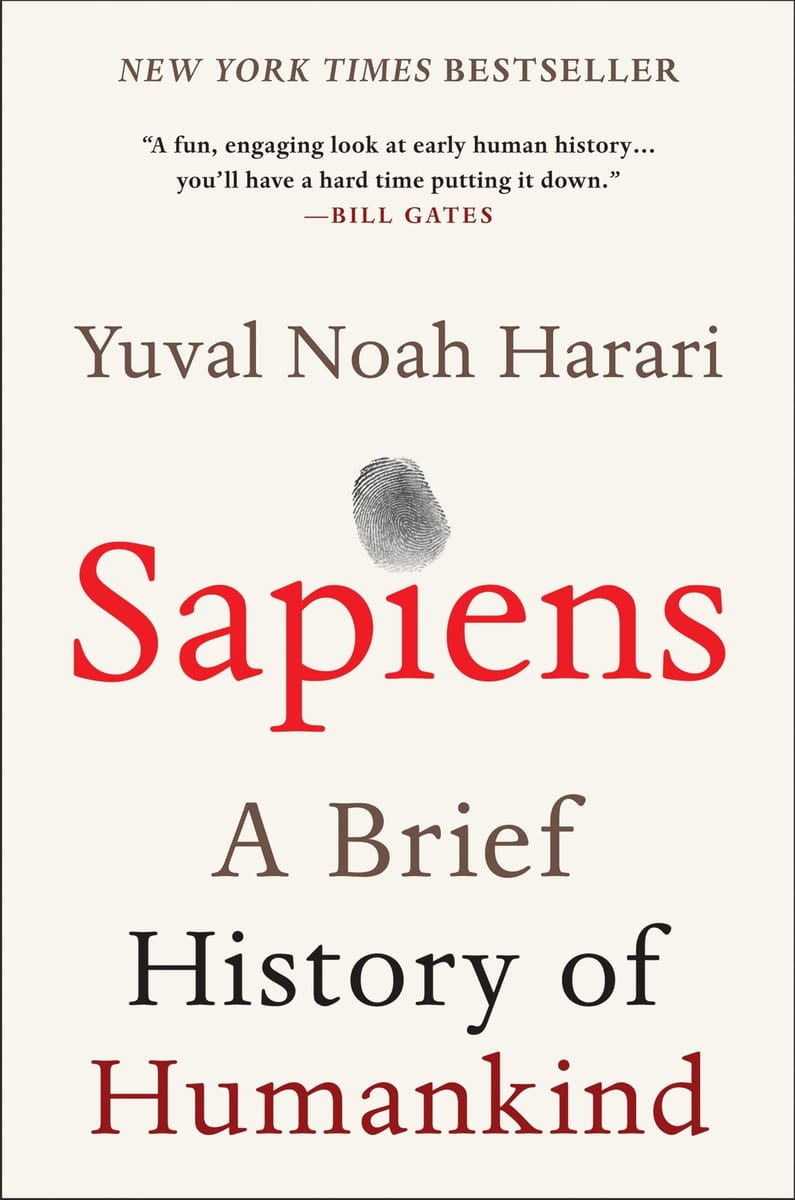
Yuval Noah Harari's book grew out of lectures he gave at the Hebrew University of Jerusalem. It was published in Hebrew in 2011 and in English in 2014, and it surveys the history of humankind from the Stone Age to the twenty-first century, mixing the natural and social sciences.
Read more
It is a sweeping account of cognition, culture and power, and it is provocative and very readable, a natural first book for this group.
For: Newcomers to history who want one sweeping overview.
While reading: Treat its boldest claims as starting points for discussion rather than settled facts.
Next: Guns, Germs, and Steel offers a different explanation for why some societies came to dominate others.
Jared Diamond asks why Eurasian and North African civilisations came to conquer others, and argues firmly against any explanation based on intellectual, moral or genetic superiority. His answer lies in geography and environment.
Read more
The book combines biology, geography, anthropology and history, and it won the Pulitzer Prize for General Nonfiction in 1998. It has also been widely criticised by experts on the regions it discusses, which makes it an ideal book to argue with.
For: Readers who like big explanations and are willing to weigh the objections too.
While reading: Look up a couple of the criticisms after you finish. Seeing where specialists push back is as instructive as the book itself.
Next: Plagues and Peoples develops the role of disease in much more depth.
William H. McNeill's 1976 book argues that infectious disease has been a major force in human history, from ancient empires to the conquest of the Americas. At the time it was a new way of looking at the subject: disease as both shaped by social and environmental conditions and shaping how cultures developed.
Read more
It was a critical and popular success, and it reads very differently after the pandemic years.
For: Readers who want to see history from an unexpected angle.
While reading: It is older and more academic in tone than Diamond. Read it in shorter sessions.
Next: The Lessons of History steps back even further, to what thousands of years of history might teach.
Will and Ariel Durant spent decades writing The Story of Civilization, a history in many volumes. After completing its tenth volume they wrote this short book, published in 1968, summarising the patterns and trends they had noticed along the way.
Read more
It is reflective rather than narrative, a distillation of a lifetime of study. It can be read in an afternoon and thought about for much longer.
For: Readers who want a short, wise book about history rather than a long history book.
While reading: Read one chapter at a time and stop to argue with it.
Next: The Better Angels of Our Nature makes a much longer and more data-driven case about one pattern in particular.
Steven Pinker argues, with extensive data, that violence of almost every kind has declined over human history, from war to the treatment of children. He points to several possible causes: states holding a monopoly on force, commerce making people more valuable alive than dead, literacy and communication spreading empathy, and a growing habit of reasoned problem-solving.
Read more
He also notes that our sense of danger has not tracked the decline, and that further progress is not guaranteed.
For: Readers who like data and are ready for a long, argumentative book.
While reading: It is very long. The opening chapters set out the argument; the rest supplies the evidence, and you can read it selectively.
Next: A People's History of the United States offers a very different, much less optimistic view of the modern past.
Mark Zuckerberg, Eric Schmidt and 2 more
Group 3: Modern history from three angles
Three books about the last two centuries, each with a different point of view: history from below, history from the war rooms, and the history of a continent rebuilding itself. Together they show how much the angle changes the story.
Howard Zinn retells American history from the perspective of workers, women, enslaved people and Native Americans rather than presidents and generals. First published in 1980 and revised several times, it was a runner-up for the National Book Award and has sold more than four million copies, much of that through word of mouth.
Read more
It has also been sharply criticised by some historians for omissions and one-sided sources, while others defend it. Either way, it changed which stories historians think worth telling.
For: Readers who want to question the standard version of American history.
While reading: Read it as a counter-narrative, deliberately one-sided, and compare a chapter or two with a conventional account.
Next: The Guns of August shows history from the other end: the decisions of governments and generals.
Barbara W. Tuchman's account of the first month of the First World War, from the decisions to go to war to the Franco-British offensive that stopped the German advance into France. After that came four years of trench warfare.
Read more
Tuchman covers military plans, strategy, world events and the international mood in great detail, and the book won the Pulitzer Prize. It is one of the best demonstrations of how a few weeks of choices can shape a century.
For: Readers who like narrative history and want to understand how the First World War began.
While reading: Keep track of the great powers' war plans described early on. The drama comes from watching them meet reality.
Next: Postwar picks up Europe's story after the second, even larger war.
Tony Judt's history covers six decades of Europe from the end of the Second World War in 1945 to 2005. Although published in 2005, it had been in development since 1989.
Read more
It is widely considered one of the leading accounts of contemporary European history, especially with regard to Eastern Europe. It is long, but it explains the Europe of today better than almost any other single book.
For: Readers who want to understand modern Europe, East and West.
While reading: Read it in sections by decade. Each part works well on its own.
Next: Turn to War and Peace for a very different kind of European history, told as a novel.
Ta-Nehisi Coates
Group 4: History as story
Two novels and two true adventures. They are the most enjoyable books on the list and prove that a well-told story can teach as much history as an essay. Mix them in between the heavier books.
Tolstoy's epic follows several aristocratic Russian families through the Napoleonic Wars and the French invasion of Russia. It mixes a fictional story with chapters in which Tolstoy discusses history and philosophy directly, and he himself refused to call it simply a novel.
Read more
It combines intimate human drama with an enormous historical canvas, and it has strong claims to being the greatest novel ever written.
For: Readers with time and patience who want to feel history from inside.
While reading: Keep a list of the main families and characters. Once the names settle, the book becomes much easier.
Next: Memoirs of Hadrian offers another novel that thinks deeply about history, at a fraction of the length.
Marguerite Yourcenar's novel, first published in France in 1951, imagines the Roman Emperor Hadrian writing a letter to his eventual successor, Marcus Aurelius. In it he reflects on military triumphs, poetry and music, philosophy and his love for Antinous.
Read more
Yourcenar chose Hadrian partly because he lived when the old Roman gods were no longer believed in and Christianity was not yet established, a moment she saw as similar to post-war Europe. The real Hadrian's autobiography is lost; this is the most convincing substitute literature has produced.
For: Readers who like reflective, beautifully written fiction set in the ancient world.
While reading: Read it slowly, a few pages at a time. It is a meditation, not a plot.
Next: Endurance switches to pure adventure and real events.
Alfred Lansing's 1959 book tells the story of the Imperial Trans-Antarctic Expedition led by Sir Ernest Shackleton, which set out in 1914 to cross the Antarctic continent and failed. What followed was an extraordinary struggle for survival.
Read more
Lansing writes it as a gripping narrative, and it has become a classic of both adventure writing and leadership.
For: Anyone who wants a true story that reads like a thriller.
While reading: Read it in as few sittings as you can. The tension builds best without long breaks.
Next: The River of Doubt is another expedition story, set in the Amazon instead of the ice.
Candice Millard's first book follows the Roosevelt-Rondon Scientific Expedition, Theodore Roosevelt's journey down the River of Doubt in Brazil, later renamed the Roosevelt River. Its subtitle calls it his darkest journey, and Millard tells it as a story of danger and endurance.
Read more
It won the William Rockhill Nelson Award and was a finalist for the Quill Awards.
For: Readers who enjoy exploration, biography and true adventure.
While reading: Read it close to Endurance to compare two expeditions and two very different leaders.
Next: Go back to the big-picture books with fresh eyes; you will see how much individual choices still matter.
Ryan Holiday
Reading path
If you are new to history, start with Sapiens or Endurance. Sapiens gives you a frame for everything else; Endurance reminds you that history is made of people. Follow either with The Lessons of History, which is short enough to read in a weekend and gives you a set of questions to carry into the longer books.
From there, alternate heavy and light. Pair Guns, Germs, and Steel with The River of Doubt, Plagues and Peoples with Memoirs of Hadrian, The Better Angels of Our Nature with The Guns of August. The alternation keeps you reading and helps the big ideas connect to concrete events.
Read more
If one region interests you more than the others, follow the first group in order: The New Roman Empire, then The Fall of the Ottomans, then Atatürk. Together they cover more than fifteen hundred years of the same part of the world. For modern Europe, read The Guns of August and then Postwar. For the United States, read A People's History alongside a more traditional account.
Save War and Peace for a long holiday or a slow season. It is best read without hurrying, and it pairs well with any of the books about the nineteenth century or about war.