Twelve readable psychology books for beginners, from Frankl and Kahneman to Quiet and Flow, grouped by question and with a suggested reading order.
0/12 books read0%
Psychology is one of the few sciences whose subject is the reader. Every chapter is, in some way, about you: why you trust a first impression, why you agree to things you did not want, why some work makes hours vanish, why the thought of death sits under so much of what we do. That is why good popular psychology is so addictive, and also why it pays to choose carefully. The shelf is crowded with books that promise to change your life in seven steps.
Read more
The twelve books below are a better starting point. Most were written by working psychologists, psychiatrists or social scientists, and several shaped their fields: Kahneman's two systems of thought, Cialdini's principles of persuasion, Csikszentmihalyi's idea of flow, Dweck's fixed and growth mindsets. Others come from outside the laboratory, such as Viktor Frankl's account of surviving the camps or Eric Hoffer's short book on mass movements, but they have influenced how psychologists think as much as any experiment.
The list is grouped by the question each book is trying to answer. The first group asks what gives a life meaning and how we cope with suffering and mortality. The second looks at the machinery of the mind: judgement, prediction, memory and self-justification. The third turns outward to persuasion and crowds. The fourth is the most practical, about temperament, ability and attention in everyday life.
A word of caution belongs at the start. Psychology has been through a replication crisis in recent years, and some studies once cited in popular books have not held up when repeated. That does not make these books worthless; it means you should read them as arguments from serious people rather than as final verdicts. Where a book has faced specific criticism, it is mentioned below.
Who it is for: Curious readers with no background in psychology who want to understand how people think, decide, persuade and find meaning, without a textbook.
Three books that ask the largest questions first. They are less about experiments than about what it means to be human, and they make an ideal entry point because they show why psychology matters before you get into how it works.
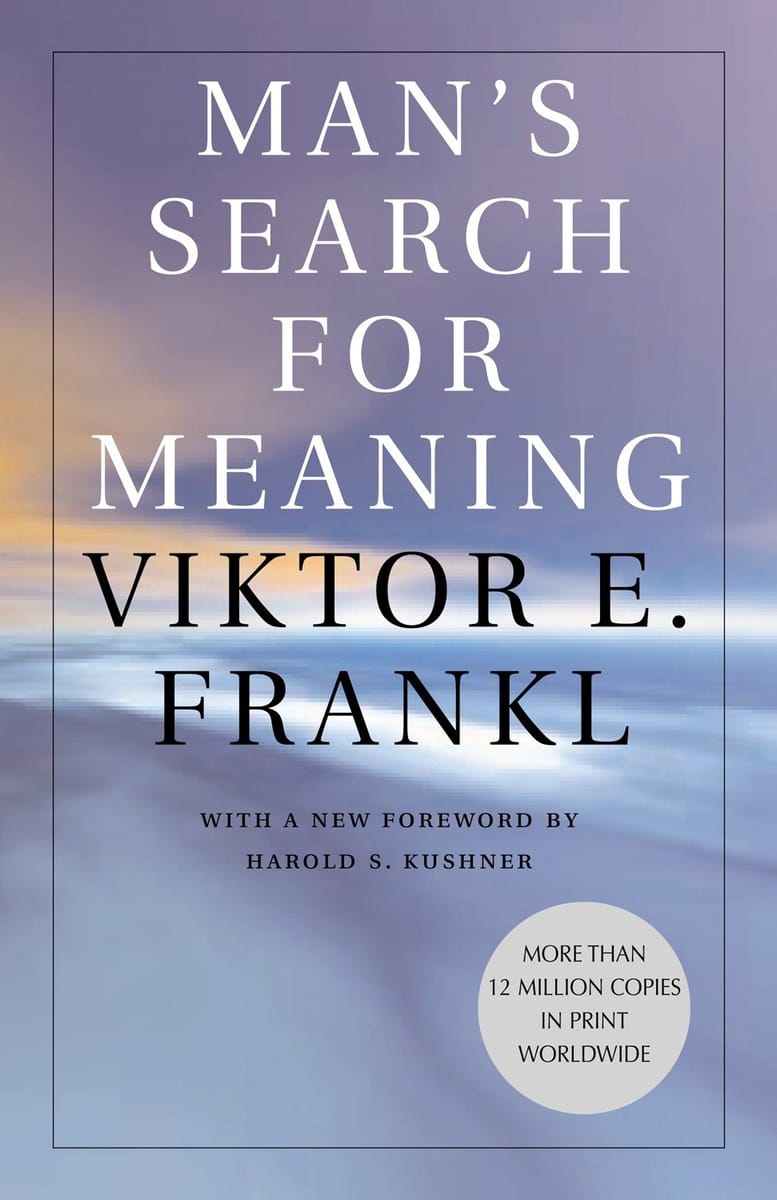
Viktor Frankl was a psychiatrist who survived Nazi concentration camps, and this 1946 book has two halves. The first describes everyday life in the camps as it was reflected in the mind of a prisoner, and Frankl's observation that people who could hold on to a purpose, even an imagined conversation with someone they loved, seemed better able to endure.
Read more
The second half sets out logotherapy, his approach built on the idea that meaning can be found through work, through caring for another person, or through facing unavoidable suffering with dignity. By the time of his death in 1997 it had sold more than ten million copies.
For: Anyone, at any age, but especially readers going through a hard stretch.
While reading: Read the first part slowly. It is short, but it is not a book to rush through on a commute.
Next: The Denial of Death takes the question of mortality further and more darkly.
Ernest Becker, a cultural anthropologist, argued that most of what humans do is an attempt to ignore or escape the knowledge that we will die, and that whole cultures are built around that avoidance. The book won the Pulitzer Prize for General Nonfiction in 1974, two months after Becker's death.
Read more
It also became the basis for terror management theory, a line of research in which psychologists have tested Becker's ideas experimentally. It is denser than anything else in this group, but few books explain so much of human behaviour with a single idea.
For: Readers who enjoyed Frankl and want something more philosophical and demanding.
While reading: Do not expect a light read. Take a chapter at a time and stop to think about how its argument applies to people you know.
Next: The Happiness Hypothesis is a gentler companion, setting old wisdom against modern research.
Jonathan Haidt, a social psychologist, takes a handful of 'Great Ideas' about happiness from thinkers of the past, including Plato, the Buddha and Jesus, and tests them against contemporary psychological research. The result is an engaging mix of philosophy and science that keeps asking which ancient advice still holds up.
Read more
Virtue, fulfilment and meaning are at the centre. It is one of the most balanced introductions to positive psychology, because it treats old traditions as hypotheses rather than either worshipping or dismissing them.
For: Readers who like philosophy and want to see what science can add to it.
While reading: Keep a note of which ancient ideas Haidt finds support for and which he does not. The tally is surprising.
Next: Stumbling on Happiness looks at the same subject from the angle of prediction.
Joe Rogan, Charles Koch and 2 more
Group 2: How the mind actually works
Four books about the hidden machinery behind judgement and behaviour. Together they show that the mind is fast, efficient and often wrong in predictable ways. Start with Kahneman, then read the others in any order.
Daniel Kahneman, a Nobel-winning psychologist, describes two modes of thought: System 1, fast, instinctive and emotional, and System 2, slow, deliberate and logical. Drawing on decades of research, much of it with Amos Tversky, he walks through loss aversion, framing, and our habit of swapping a hard question for an easier one, and concludes that we place too much confidence in human judgement.
Read more
It won the National Academies Communication Award in 2012. Some of the priming studies it cites have since been questioned during the replication crisis, which is worth knowing as you read.
For: Anyone who wants the single most influential popular book on how we make decisions.
While reading: It is long and dense. Read the first part closely, then feel free to dip into the rest by chapter.
Next: Mistakes Were Made (But Not by Me) shows what happens after a bad decision.
Daniel Gilbert, a psychologist, explains why we are so bad at predicting what will make us happy. His subject is the gap between the future we imagine and the future we actually live, and he treats our forecasts of our own feelings as something science can study.
Read more
The book is entertaining, often funny, and has been translated into more than thirty languages. It is a good complement to Kahneman, because it applies the same kind of thinking about bias to the question everyone actually cares about.
For: Readers facing a big decision, or anyone who has got what they wanted and felt strangely flat.
While reading: Try to predict your own reactions to small events while reading. It makes Gilbert's point very personal.
Next: Flow offers the other half of the picture: what actually makes experience good.
Carol Tavris and Elliot Aronson explain why people find it so hard to admit mistakes, and how self-justification works to protect the way we see ourselves. Their subject is the quiet mental work we all do to convince ourselves that we were right all along.
Read more
It is a lively, clear book, and it changes how you listen to apologies, including your own. Few books in this list are as directly useful in daily life.
For: Readers interested in why arguments go nowhere and why people dig in.
While reading: Notice moments in your own week when you explain away a mistake. The book turns into a mirror quickly.
Next: The True Believer shows the same mechanism at the scale of whole movements.
Robert Sapolsky, a neuroscientist, asks why we behave as we do, and answers on a sliding scale of time, from what happens in the brain a second before an act to the forces that shaped us thousands of years earlier. It is the longest and most scientific book in this group, but Sapolsky writes with humour and clarity.
Read more
It gives the biological foundation that the other books mostly leave out.
For: Readers who want to understand the biology behind behaviour and do not mind a big book.
While reading: Follow the structure: the book keeps stepping further back in time from the same moment. Keeping that in mind makes the size manageable.
Next: After Sapolsky, Quiet will feel like a welcome change of pace.
Bryan Johnson, Marc Andreessen
Group 3: Persuasion and crowds
Two books about the psychology of influence: one at the level of a single sales pitch, the other at the level of mass movements. Reading them together shows how the same human needs can be used in very different ways.
Robert Cialdini, a psychology professor at Arizona State University, sets out the principles that 'compliance professionals' use to get us to say yes, from reciprocity to social proof. His starting point is that in a world with too much information we fall back on mental shortcuts, which usually serve us well but can be exploited.
Read more
Cialdini went undercover in fields such as car sales and door-to-door sales to see the principles in action, and later editions added a seventh, unity. It has sold more than two million copies in over twenty languages.
For: Anyone who buys things, sells things, or wants to spot manipulation.
While reading: Keep the list of principles in mind and look for them in advertising for a week. They are everywhere.
Next: The True Believer scales the same questions up from customers to crowds.
Eric Hoffer, an American social philosopher, published this short book in 1951 to explain why mass movements arise and why people join them. His argument is that fanatics of very different causes share a similar psychology, drawing on world history and social psychology, and he looks closely at how a sense of identity and attachment to ideals can lead both leaders and followers into extremism.
Read more
It is written in short, aphoristic sections that are easy to read and hard to forget.
For: Readers interested in politics, history and the psychology of belonging.
While reading: Read it slowly despite its length; many single paragraphs could be discussed for an hour.
Next: Return to Frankl, whose answer to the need for meaning is very different from the one Hoffer describes.
Mark Cuban, Marc Andreessen and 2 more
Group 4: Temperament, ability and attention
Three books that are closest to everyday life. They deal with how we see our own abilities, how different temperaments fit into the world, and what makes an activity absorbing. They are the easiest to apply, and a good place to finish.
Carol Dweck, a Stanford psychologist known for her research on motivation, contrasts two beliefs about ability. With a fixed mindset, talent is something you have or do not; with a growth mindset, ability is something you develop.
Read more
Dweck shows how these beliefs about ability shape success and the way people respond to difficulty. It has become one of the most influential psychology books of its time.
For: Students, parents, teachers and anyone who avoids things they might fail at.
While reading: Ask yourself which mindset you bring to different parts of your life. Most people find they hold both, depending on the subject.
Next: Quiet adds the question of temperament to Dweck's question of ability.
Susan Cain argues that Western culture undervalues introverts, and traces a shift from a culture of character to a culture of personality in which an 'extrovert ideal' dominates. Drawing on biology, psychology and neuroscience, she treats introversion and extroversion as preferences for different levels of stimulation and shows that introversion is both common and normal.
Read more
She ends with practical suggestions for workplaces, schools, parents and relationships between people of different temperaments.
For: Introverts who have been told to speak up more, and the extroverts who live and work with them.
While reading: Read it without trying to label yourself too quickly. Cain is more interested in a range than in two boxes.
Next: Flow shows what happens when any temperament finds the right level of challenge.
Mihaly Csikszentmihalyi's study of flow, the state of complete absorption in an activity, often described as being in the zone. He first presented the concept in a 1975 book, and this 1990 book is devoted to it.
Read more
Flow happens when the challenge of a task matches your level of skill, so that you are neither bored nor overwhelmed, and it often changes your sense of time. The idea has since spread into sport, education, work and therapy.
For: Readers who want to understand why some hours vanish and others drag.
While reading: Think of your own flow activities while you read. The book is most useful as a lens on your own days.
Next: Go back to The Happiness Hypothesis to see how flow fits into a wider picture of a good life.
Susan Cain, Ted Gioia
Reading path
For a first book, choose between Man's Search for Meaning and Thinking, Fast and Slow. Frankl is short and moving and needs no background; Kahneman is long and analytical, but it gives you the vocabulary that much of modern popular psychology uses. If you are unsure, start with Frankl and keep Kahneman for when you have more time.
After that, a balanced route is: Influence, Mindset, Quiet, then Stumbling on Happiness. These four are readable, practical and cover persuasion, ability, temperament and prediction. Add Mistakes Were Made whenever you need a short, sharp book between longer ones.
Read more
Leave The Denial of Death and Behave for later. Both are demanding, one philosophically and one scientifically, and both are more rewarding once the shorter books have given you a map. The True Believer and The Happiness Hypothesis can go anywhere in the sequence; they are good choices for a week when you want ideas rather than data.
One habit helps with every book on this list: test the claims against your own life and the people around you, but hold them loosely. Psychology is a young science and some of its findings are still being revised. Read these as the best current thinking of serious people, not as rules.