What entrepreneurs read: 14 books founders keep returning to
The books on real founders' shelves: Zero to One, Shoe Dog, High Output Management, The Intelligent Investor and ten more, with a reading order.
0/14 books read0%
Business shelves are crowded with books that promise a formula. The ones founders actually return to tend to be different. They are often stories rather than systems, they admit how much luck and confusion goes into building anything, and many of them are decades old. A book on value investing from 1949 and a collection of New Yorker essays from 1969 sit next to startup manuals from the last fifteen years, and they hold their place for the same reason: they describe problems that never go away.
Read more
The fourteen books below all appear on the reading lists of well-known entrepreneurs, investors and executives. Shoe Dog is shared by Bill Gates, Warren Buffett, Tim Cook and Alexis Ohanian. The Hard Thing About Hard Things is named by Marc Andreessen, Michael Dell, Dustin Moskovitz and Bryan Johnson. The Innovator's Dilemma links Steve Jobs, Jeff Bezos, Mark Cuban and Marc Andreessen.
The books are arranged in four groups that follow the life of a company: the moment of starting, the daily work of running it, the stories of firms that rose and fell, and finally money itself. You do not need to read them in that order, and nobody needs all fourteen. A founder in the first year will get more from two books in the first group than from the whole list skimmed in a month.
One thing worth noticing before you start is how few of these books are about tactics. Only a couple tell you what to do on Monday morning. Most are about judgement: how to think about competition, when to trust your own view against the market, how to keep a creative team honest, why a giant company can be beaten by a small one. That is probably why they last. Tactics go out of date with the tools they depend on, while questions about people, risk and patience come back with every new company.
Who it is for: People starting or running a company, and anyone curious about which books the founders and investors they admire actually keep on their shelves.
Three books about the earliest and most uncertain stage of a company. They disagree in useful ways. Peter Thiel argues for bold, original bets; Eric Ries argues for small experiments and learning fast; Ben Horowitz writes about what happens once the company exists and things start to go wrong. Read together, they cover the founder's first few years from three angles.
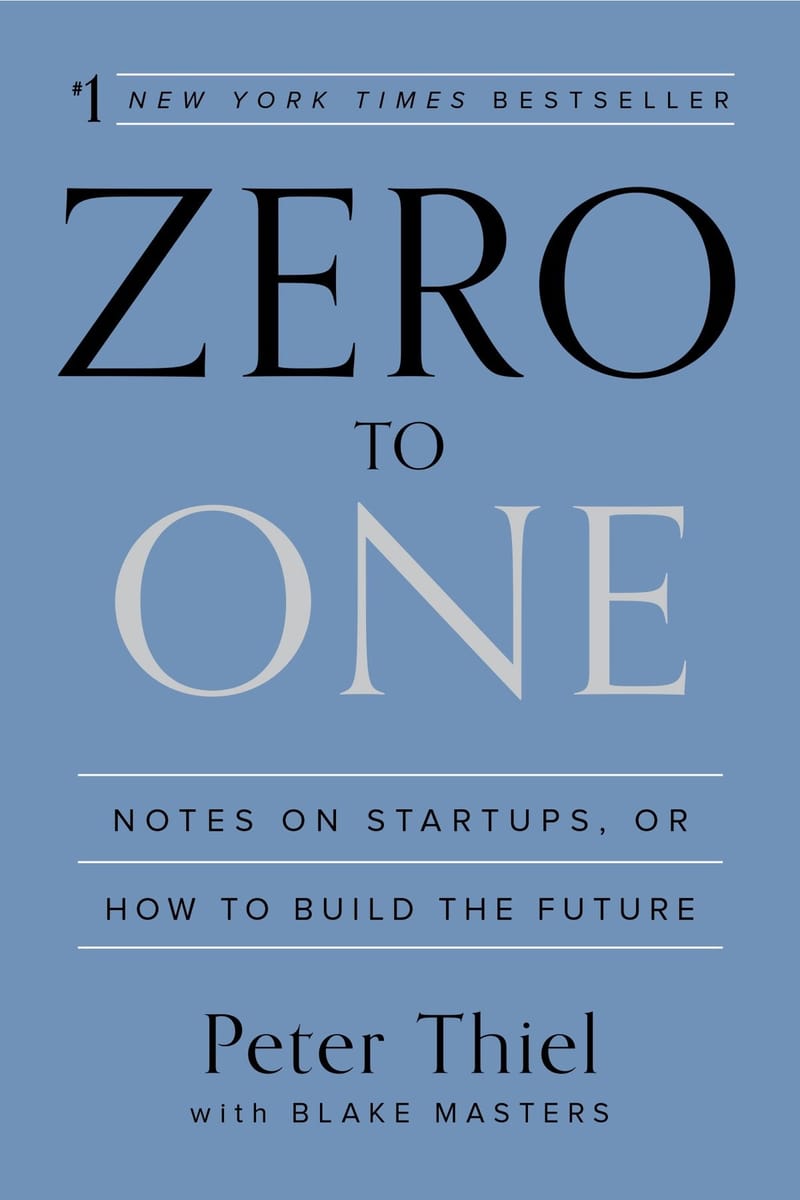
Peter Thiel argues that real progress means creating something new rather than copying what already works. The book grew out of notes that Blake Masters, then a student, took during the class on startups Thiel taught at Stanford in 2012, and Masters is its co-author.
Read more
It reads as a contrarian argument rather than a manual, and its central question is a demanding one: what does your company know that others do not? On founders' shelves it is everywhere. Dustin Moskovitz, Luis von Ahn and Bryan Johnson all list it, and so does the media executive Rupert Murdoch.
For: Founders and would-be founders who want to test whether their idea is genuinely new or a copy of something that already exists.
While reading: Keep a note of your own business idea beside you and answer each of Thiel's questions about it honestly; the book works best as an argument you push back against.
Next: The Lean Startup offers the opposite temperament: fewer grand theories and more testing in small steps.
Eric Ries introduces a method for building startups through rapid experiments and what he calls validated learning. The idea is to release a minimum viable product, watch how real users respond and refine the offering from there, instead of spending a year building something in secret.
Read more
The approach draws on lean manufacturing and agile software development, and Ries developed it after difficulties with his own first company. Mark Cuban, Sheryl Sandberg and Kevin Systrom all keep it on their lists, which says something about how widely its vocabulary has spread.
For: Anyone launching a product with limited money and time, whether a software company, a shop or a project inside a larger organisation.
While reading: Pick one assumption about your customers that you have never checked and design the smallest possible test for it while you read.
Next: The Hard Thing About Hard Things picks up where experiments end, with the decisions no test can make for you.
Ben Horowitz writes candidly about what it takes to run a company when there are no easy answers. Drawing on his years as a startup chief executive, he gives practical and often blunt advice on situations most business books avoid: laying people off, demoting a friend, keeping a company alive when the money is running out.
Read more
It is the most widely shared book in this group among founders and investors. Marc Andreessen, Michael Dell, Dustin Moskovitz, Bryan Johnson and Luis von Ahn all name it, and so do Andrew Ng and the physician Peter Attia.
For: First-time chief executives and managers who suspect that the hardest part of the job is not the strategy but the people.
While reading: Read the chapters as they become relevant rather than all at once; many readers keep it on the desk and open it when a specific crisis arrives.
Next: High Output Management gives the calmer, more systematic version of the same job.
Michael Dell, Bryan Johnson and 5 more
Group 2: Running the company day to day
Once a company has people, processes and customers, the questions change. These four books deal with management, operations and culture. Two are written by people who ran famous companies, one is a novel about a factory, and one is a research project on why some firms improve and others stall. They are less exciting than the founder stories but probably more useful in an ordinary week.
Intel's Andy Grove explains how to run an organisation, and he starts from a simple definition: a manager's output is the output of the group they lead. First published in 1983, the book describes the management and productivity ideas Grove used at Intel, including objectives and key results, the goal-setting method now known everywhere as OKRs.
Read more
It is plain, practical and surprisingly short on theory. Marc Andreessen, Larry Ellison and Brian Chesky all list it, and it is the kind of book people pass to a newly promoted manager.
For: New managers, team leads and founders whose company has just grown past the size where everyone sits in one room.
While reading: Translate each idea into your own team as you go: which meetings produce output and which do not, which reports actually change decisions.
Next: The Goal shows the same kind of thinking at work on a factory floor, told as a story.
Eliyahu Goldratt's business novel teaches the theory of constraints through the story of a plant manager who is given three months to save his factory. The plot carries the ideas: instead of reading about bottlenecks in the abstract, you watch a frustrated manager discover them one by one.
Read more
It is a lively introduction to operations thinking and an unusual case of a management idea spread through fiction. Jeff Bezos and Kevin Systrom have it on their lists, as does MrBeast, whose business runs on a very different kind of production line.
For: Anyone who manages a process, from manufacturing to software releases to video production, and wants to understand why work piles up in some places and not others.
While reading: Each time the manager finds a bottleneck, ask where the equivalent sits in your own work; the exercise is the point of the book.
Next: Good to Great moves from one factory to whole companies and asks why some keep improving.
Jim Collins and his research team studied why some companies make the leap from good to great and most do not. Published in 2001, it became a bestseller with around four million copies sold, reaching far beyond the usual audience for management books.
Read more
Its argument is built around disciplined people, disciplined thought and disciplined action, and its tone is that of a long research report rather than a motivational talk. Jeff Bezos has it on his list. Read it alongside Lights Out in the next group for a useful reminder that admired companies do not stay admired for ever.
For: Leaders of established companies, and anyone interested in the long, unglamorous work of improving an organisation that already works.
While reading: Treat the companies in the book as examples of ideas rather than as permanent models; what matters is the pattern, not whether each firm kept its place.
Next: Creativity, Inc. tests the same questions inside a studio where the product is art.
Ed Catmull, co-founder and president of Pixar, describes how the studio built a culture of creativity and candour. Written with Amy Wallace and published in 2014, it is part management guide and part company history, and its most memorable passages are about how a group of very talented people learned to criticise each other's work without destroying it.
Read more
Mark Zuckerberg, Alexis Ohanian and Demis Hassabis all list it, as does the journalist Ezra Klein.
For: People who lead creative or technical teams, where the work cannot be measured as easily as units on a production line.
While reading: Notice how often Catmull describes mistakes rather than successes; the book is more honest about failure than most company histories.
Next: The Ride of a Lifetime tells the story from the other side, through the executive who bought Pixar for Disney.
Mark Zuckerberg, Demis Hassabis and 2 more
Group 3: How companies rise and fall
Five books of stories: two memoirs by people who built or led famous companies, two reported accounts of corporate triumph and disaster, and one theory that explains why large, well-run firms are so often overtaken. These are the books founders tend to recommend to each other, because a good story stays in the memory longer than a framework.
Nike co-founder Phil Knight recounts the early and precarious years of building the company. It is a warm, candid memoir of risk, rivalry and perseverance, and it is striking how close to failure the business came for so long.
Read more
It is one of the most widely shared books on entrepreneurs' lists. Bill Gates, Warren Buffett, Tim Cook and Alexis Ohanian all name it, a range of readers that runs from software to investing to the world's most valuable technology company.
For: Anyone who thinks successful companies were obvious from the start, and anyone currently living through the precarious years themselves.
While reading: Read it as a story first. The lessons about cash, partners and suppliers emerge naturally, without the author pointing at them.
Next: The Ride of a Lifetime shows what leadership looks like at the other end of a company's life, when it is already enormous.
Robert Iger recounts fifteen years as chief executive of Disney, a period that included major acquisitions such as Pixar and Marvel. It is a memoir of leadership and change at enormous scale, and a natural companion to Creativity, Inc., which describes one of those acquisitions from inside the studio that was bought.
Read more
Brian Chesky, Alexis Ohanian, Michael Bloomberg and Karlie Kloss all list it, as does Tim Ferriss.
For: Readers interested in how a very large company changes direction, and founders who want to understand the people who might one day buy their business.
While reading: Read it after Creativity, Inc. if you can, so that you see the Pixar deal from both sides.
Next: Business Adventures offers older and stranger corporate stories, told by one of the best business writers of his time.
John Brooks's 1969 collection contains twelve true stories from Wall Street and corporate America, all first published in The New Yorker. The essays are widely praised for their clear, lively storytelling, and the fact that they are more than half a century old matters less than you would expect: greed, panic and corporate misjudgement have not changed much.
Read more
Bill Gates, Michael Dell and Patrick Collison all list it, a rare case of a book from the 1960s being passed between technology founders.
For: Readers who like long-form journalism and want business history told as narrative rather than as lessons.
While reading: Read one essay at a time; each stands alone, and they are best enjoyed with a pause between them.
Next: Lights Out is a modern example of the same genre, following one company's long decline in detail.
Thomas Gryta and Ted Mann chronicle the fall of General Electric, from admired industrial giant to cautionary tale. It is a reported account of ambition, financial engineering and decline, and it makes a sobering partner to the success stories elsewhere on this list.
Read more
Bill Gates and Jeff Bezos both have it on their shelves, which says something about how seriously the people who build large companies take stories of how they collapse.
For: Managers and investors who want to understand how a company can look strong from outside while weakening from within.
While reading: Keep Good to Great in mind as you read; the contrast between admired companies and their later fate is part of what makes this book useful.
Next: The Innovator's Dilemma explains a different way great companies fail, through technologies they chose to ignore.
Clayton Christensen explains why successful companies fail when disruptive technologies arrive. First published in 1997, the book argues that large firms lose ground precisely by doing what seems sensible: listening to their best customers and improving their most profitable products.
Read more
Meanwhile, newcomers serve less demanding customers with cruder technology and improve it until it is good enough to take the market. Christensen's advice is for large companies to keep small, nimble units that can compete with the newcomers. Steve Jobs, Jeff Bezos, Mark Cuban and Marc Andreessen all list it.
For: Founders looking for a gap that large companies cannot easily fill, and executives who worry about being on the other side of that gap.
While reading: Think of an industry you know well and try to identify which current product could be the cruder newcomer Christensen describes.
Next: The Intelligent Investor turns from companies to the question of how to value them.
Jeff Bezos, Steve Jobs and 2 more
Group 4: Money and patience
Two books about money, one from 1949 and one from 2020. Both argue that temperament matters more than intelligence when it comes to wealth, and both are as useful to someone running a company as to someone managing savings.
Benjamin Graham's classic on value investing teaches patience, discipline and a margin of safety. Warren Buffett has called it the best book about investing ever written.
Read more
It is not a quick read, and some chapters deal with markets and instruments of its own era, but its core idea is simple and lasting: know what something is worth before you decide what to pay for it.
For: Anyone who invests, or who will one day have to decide what to do with the proceeds of their own company.
While reading: Focus on the chapters about the investor's temperament and the margin of safety first; they are the heart of the book.
Next: The Psychology of Money makes the same case about temperament in shorter, more modern form.
Morgan Housel's 2020 book examines how people think about money, and how behaviour and emotion shape financial decisions far more than spreadsheets do. It is short and approachable, organised as a series of separate chapters that can be read in any order.
Read more
Ryan Holiday and Ali Abdaal both list it. For entrepreneurs, it is a useful reminder that the habits that build a company, such as appetite for risk and comfort with uncertainty, are not always the habits that keep personal wealth safe.
For: Readers who find classic investing books heavy going and want the main ideas about money and behaviour in a lighter form.
While reading: Read a chapter at a time and test it against your own decisions; its value lies in recognising yourself in the examples.
Next: Go back to Shoe Dog or Business Adventures and notice how often money, not product, decided the outcome.
Ryan Holiday
Reading path
If you are about to start a company, begin with Zero to One and The Lean Startup back to back. They pull in different directions, and deciding where you stand between them is a useful exercise in itself. Then read Shoe Dog for encouragement, because it shows how long a now-famous company spent on the edge of failure.
If you already run a team, start with High Output Management and The Hard Thing About Hard Things. The first gives you a system; the second tells you what to do when the system breaks. Add The Goal if your work involves any kind of process, and Creativity, Inc. if your team makes things that cannot be measured in units.
Read more
If you are mainly curious about how businesses work, the stories are the best way in. Read Business Adventures, then Lights Out, then The Innovator's Dilemma, which explains in theory what the other two show in practice. Finish with The Psychology of Money and, if it holds your interest, The Intelligent Investor. Fourteen books is a lot; three or four chosen for where you are right now will do more good than all of them read in a hurry, and the rest will still be there when your company reaches the stage they describe.